
.png)
Dr Max is a pharmacy chain with a broad assortment of products including prescription medications, supplements, and personal care products. Communication around products in this industry is sensitive, which means promotional materials must be created responsibly and accurately.
Catalogs are an important promotional channel for Dr Max. They communicate discounts and promotions, but ideally they also serve as a tool to educate customers.
Dr Max publishes two monthly catalogs (for the Dr Max and Super Dr Max pharmacy formats), each featuring around 400 SKUs. Many of these products are grouped into bundles or product sets.
At the same time the project started, the company also introduced a new group-level brand book and template, which the local chain needed to adopt.
Before the project began, catalog production at Dr Max relied entirely on one in-house designer responsible for:
This process created significant operational pressure.
Beyond the operational challenges, the catalog also had limited sales impact.
As seen in the old version, products were presented with only a name, price, and image. There was no capacity to properly explain pharmaceutical products, provide educational context, or guide customers toward better purchasing decisions.
The original goal of the project was to analyze the existing catalog offer and implement a system that could improve sales performance.
But once we entered the real workflow, it became clear that sales impact could not improve while the catalog process remained error-prone and designer-dependent.
Automating catalog production became a necessary first step.
Within the Dr Max environment, our system now:
The marketing team now has full control over the content and structure of the catalog.
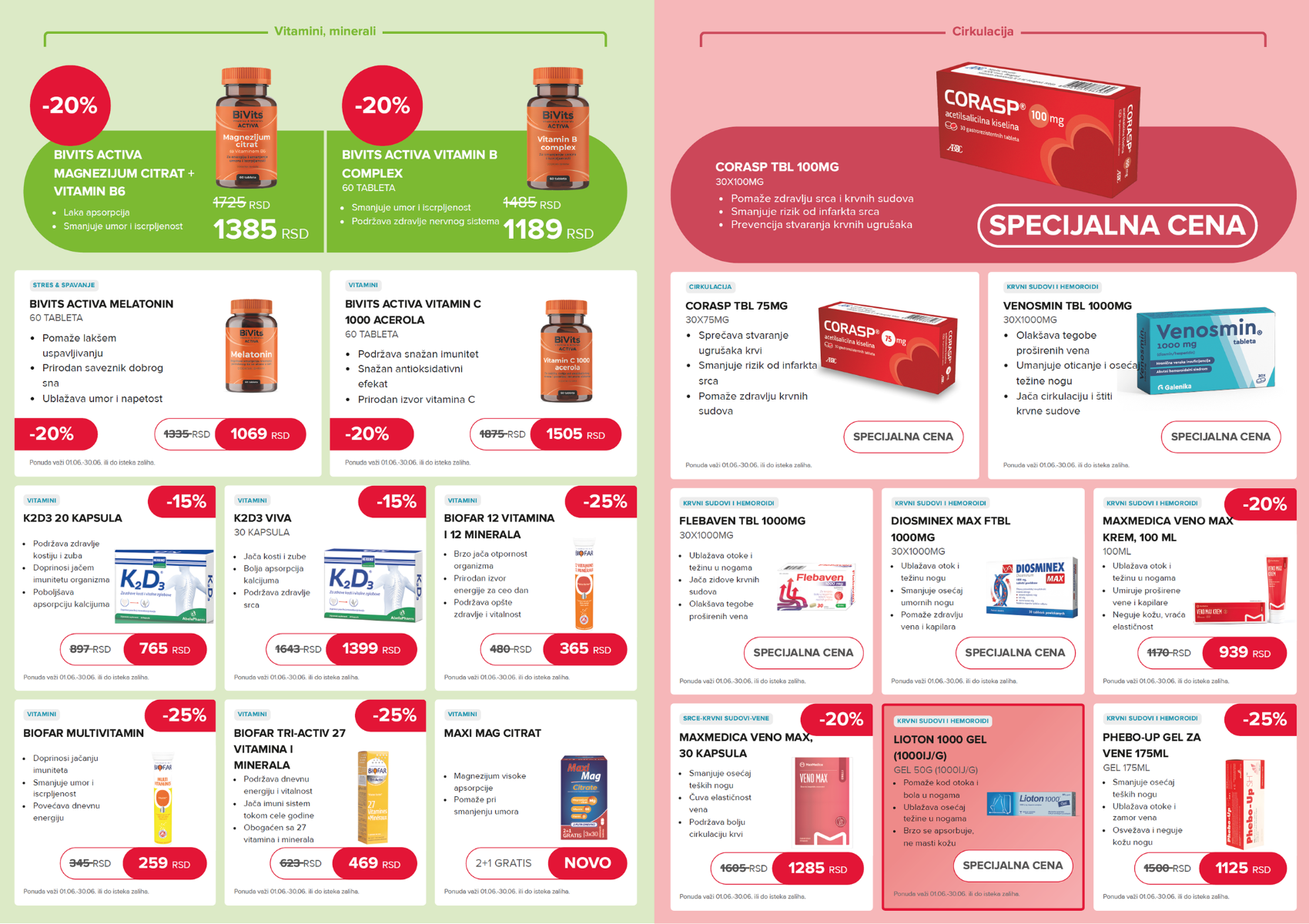
The system automatically composes pages using the group-approved template, while pulling product images and improving their quality when necessary.
At the same time, product communication has been redesigned for a B2C context.
We introduced a rule that:
This creates a much clearer and more persuasive catalog.
To implement the system, Dr Max provided:
Once connected to the product and image databases, we integrated the template to ensure the catalog output always remains brand-consistent.
We also implemented AI functions to:
Low-quality images
→ Automated image processing and preparation
Distributor-style descriptions
→ AI rewriting of all product descriptions at scale
Need for consistent output
→ Templates, rules, and quality checkpoints
The catalog is now produced in one day, compared to the previous 7–12 days per catalog cycle.
This brought several operational benefits:
At the same time, the catalog itself became visually stronger and the design team is now free to focus on brand-building work instead of production tasks.
Success was measured across two categories: operational efficiency and sales performance.
Since the project originally started with the goal of improving sales, we also implemented an AI algorithm that analyzes past sales and recommends optimal product placement within the catalog.
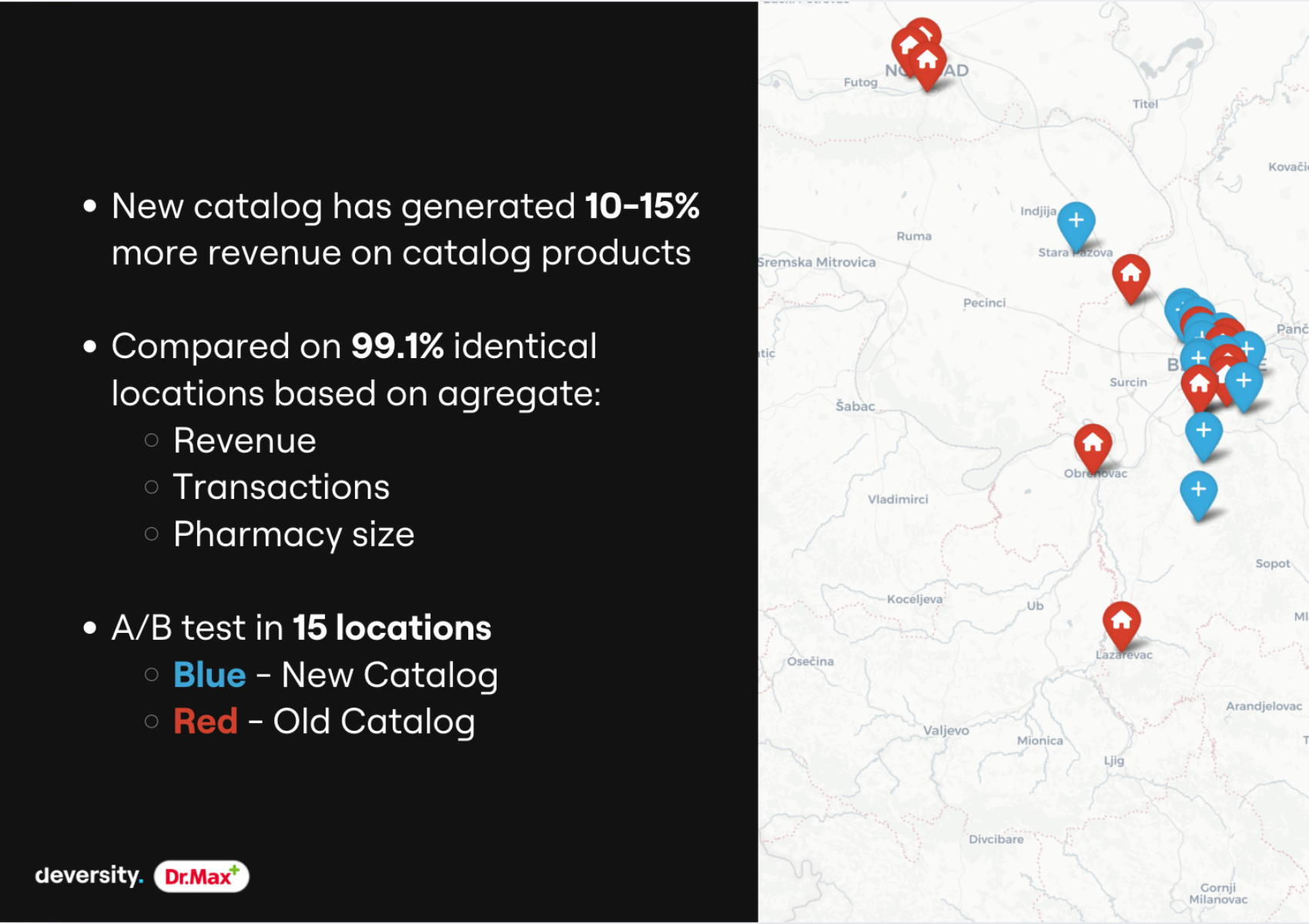
During summer 2025, we ran an A/B test across 15 comparable pharmacies (99.1% identical in transaction volume, store size, and revenue).
Some locations received the old catalog, while others received the new optimized version, allowing us to compare performance.
In both test months, the catalog using our optimized product layout generated higher sales than the previous version.
Combined with operational savings and the increased flexibility for the marketing team, the project delivered significant value for Dr Max.
In industries like pharmaceuticals, catalogs are not just promotional materials — they are also an opportunity to:
For that reason, catalogs in this sector must be informative, precise, and consistent.
This makes catalog strategy a serious marketing effort — which means it makes little sense for teams to spend most of their time on manual production work.
Once production is automated, marketing teams gain what they actually need: the time and space to improve messaging and relevance instead of simply surviving the production process every month.
.png)
Get it in 30 seconds from your Excel. Print and digital ready, single-tool with no designer needed, easier than ever.
LET'S TALK